
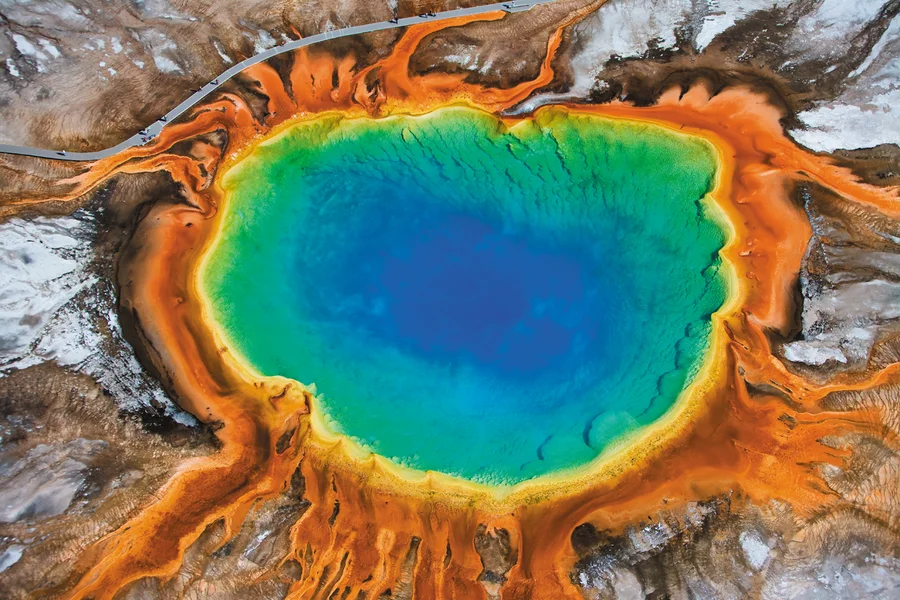
Deep oceans were thought to hold life’s origins. New evidence points instead to an active volcanic landscape
By Martin J. Van Kranendonk, David W. Deamer & Tara Djokic
It’s pitch-black. We have been scratching our way through dense underbrush in northwestern Australia, guided only by the dim light from a GPS screen. The light is too weak to reveal fallen trees that fill the dry creek bed we are following, and we keep tripping over them. We are two geologists working in a remote region of the country known as the Pilbara: Djokic up front and Van Kranendonk several steps behind. Our truck, parked somewhere on a small plateau, seems a world away. We are not sure if the GPS’s batteries will hold out long enough to show us the way back. The night sky, ablaze with countless stars visible right down to the horizon, twinkles in an amazing spectacle as Jupiter dances with nearby Venus. Sadly, this spectacle provides little navigational help for two scientists fumbling their way through the Australian outback in June 2014.
Heading up the side of the creek embankment, Djokic suddenly stumbles back downhill. Has she lost her balance? To stop her from falling, Van Kranendonk reaches out to stop her and pushes her back uphill, which prompts a screech, something unintelligible, and finally a sputtered cry: “Sp- … p- … p- … pppider!” Djokic has not stumbled at all. She is in flight mode, in fear for her life as she tries to swat away the thick spider web enveloping her. Spiders have a deservedly bad reputation in Australia. In the dark, it is not a good idea to assume that you have found the odd benign species.
The reason we are feeling our way around the Pilbara at night is because we had spent the day enthralled by a new discovery Djokic had made in 3.48-billion-year-old sedimentary rocks called the Dresser Formation. Some of the rocks are wrinkled orange and white layers, called geyserite, which were created by a volcanic geyser on Earth’s surface. They revealed bubbles formed when gas was trapped in a sticky film, most likely produced by a thin layer of bacterialike microorganisms. The surface rocks and indications of biofilms support a new idea about one of the oldest mysteries on the planet: how and where life got started. The evidence pointed to volcanic hot springs and pools, on land, about 3.5 billion years ago.
This is a far different picture of life’s origins from the one scientists have been sketching since 1977. That was the year the research submarine Alvin discovered hydrothermal vents at the bottom of the Pacific Ocean pumping out minerals containing iron and sulfur and gases such as methane and hydrogen sulfide, surrounded by primitive bacteria and large worms. It was a thriving ecosystem. Biologists have since theorized that such vents, protected from the cataclysms wracking Earth’s surface about four billion years ago, could have provided the energy, nutrients and a safe haven for life to begin. But the theory has problems. The big one is that the ocean has a lot of water, and in it the needed molecules might spread out too quickly to interact and form cell membranes and primitive metabolisms.
Now we and others believe land pools that repeatedly dry out and then get wet again could be much better places. The pools have heat to catalyze reactions, dry spells in which complex molecules called polymers can be formed from simpler units, wet spells that float these polymers around, and further drying periods that maroon them in tiny cavities where they can interact and even become concentrated in compartments of fatty acids—the prototypes of cell membranes.
Πηγή: Life on Earth Came from a Hot Volcanic Pool, Not the Sea, New Evidence Suggests